
Affiliate Disclosure: This website is an independent affiliate site. We may earn a commission if you purchase through links on this page, at no extra cost to you. See our full disclosure and editorial policy.
Short answer: the interventions with the best evidence for managing stress are unglamorous and structural — regular aerobic exercise, consistent sleep, and cognitive behavioural techniques. The acute tools most people reach for first, like breathing exercises and relaxation devices, do work, but they operate downstream. They help you come down after activation; they do not reduce how much activation arrives.
This article ranks the options by strength of evidence, which means the boring ones come first. If you are here looking for something you have not tried, skip to the sections on cognitive techniques and nerve stimulation — but do not skip past exercise and sleep on the grounds that you already know about them. Knowing about them and doing them consistently are different states.
Nothing here is medical advice. If stress is interfering with your ability to function, or you are experiencing persistent low mood or anxiety, that is a clinical matter and deserves a physician rather than an article.
What Stress Actually Is
Stress is not an emotion. It is a coordinated physiological response: the sympathetic nervous system activates, adrenaline releases within seconds, cortisol follows over minutes, heart rate and blood pressure rise, and energy is redirected toward immediate action and away from digestion, repair and long-term maintenance.
This is an excellent system. It exists because it works. The problem is not that it activates — it is that in modern life it activates repeatedly and never fully resolves, because the stressors are social and chronic rather than physical and brief. There is no moment where the threat is over.
That reframes the goal. You are not trying to feel no stress. You are trying to restore the recovery phase — the return to baseline that a deadline-shaped stressor never signals.
Tier One: The Two That Change the Baseline
Aerobic exercise
The most consistently supported stress intervention that exists, and the one most reliably ignored because the advice is old.
Exercise works on stress through several channels at once. It completes the stress cycle physiologically — the mobilised energy actually gets used, which is what the response was designed for. It improves heart rate variability over weeks, meaning a nervous system that recovers faster. It improves sleep quality, which feeds back into stress tolerance. And it provides a reliable acute mood effect afterwards.
The threshold is lower than people assume. Roughly 150 minutes a week of moderate activity is the common public health target, and brisk walking counts. Consistency beats intensity comfortably here — three thirty-minute walks a week that you actually do outperform a gym plan you abandon in February.
Sleep regularity
Stress and sleep form a loop that runs in both directions. Stress fragments sleep; poor sleep reduces the prefrontal regulation that keeps stress responses proportionate. One bad night measurably lowers your threshold for the next day's irritation.
The lever with the most leverage is regularity rather than duration. A consistent wake time, seven days a week, stabilises the circadian system more effectively than trying to extend total sleep. If you fix one thing, fix that.
We cover the mechanics separately in five drug-free ways to fall asleep faster.
Tier Two: Cognitive and Social
Cognitive behavioural techniques
CBT has the strongest evidence base of any psychological intervention for stress and anxiety, and it is frequently dismissed by people who think it means positive thinking. It does not.
CBT is skills training. You learn to notice the specific interpretation that turns an event into a threat, examine whether that interpretation survives contact with evidence, and change the behaviour that follows from it. The reason it holds up after treatment ends is that you keep the skills — unlike an intervention whose effect stops when you stop doing it.
You do not necessarily need a therapist to start. Structured self-help programmes and thought-record exercises are well established. But if stress is significantly affecting your life, a few sessions with someone trained will do more than a year of reading about it.
Social connection
Underrated because it does not sound like an intervention. Social support consistently predicts stress resilience and health outcomes, and social withdrawal is one of the earliest behavioural signs of stress overload — which makes it a trap: the thing that would help is the first thing to go.
This does not require a large network. It requires a small number of people you can be honest with, contacted regularly rather than in crisis.
Tier Three: The Acute Tools
These work on the moment rather than the baseline. That is a real function — just not the same function as the tiers above.
Slow breathing
Free, immediate and physiologically real. Exhaling longer than you inhale increases vagal activity and raises heart rate variability, shifting the autonomic balance toward parasympathetic. Roughly six breaths a minute is where most of the effect appears. Ten minutes; a shorter attempt is not a fair test.
The honest limit: it reduces physiological arousal without touching the thought loop driving it. People who conclude breathing "does not work" usually tried it during an active rumination spiral and expected it to stop the thoughts. It will not. Pair it with something cognitive.
Deliberate recovery blocks
Stress that never resolves is largely a scheduling problem. A day of back-to-back obligations with no gaps provides no recovery window at all. Short, protected pauses — genuinely away from a screen — allow the return to baseline that the stressor never signals. Fifteen minutes counts.
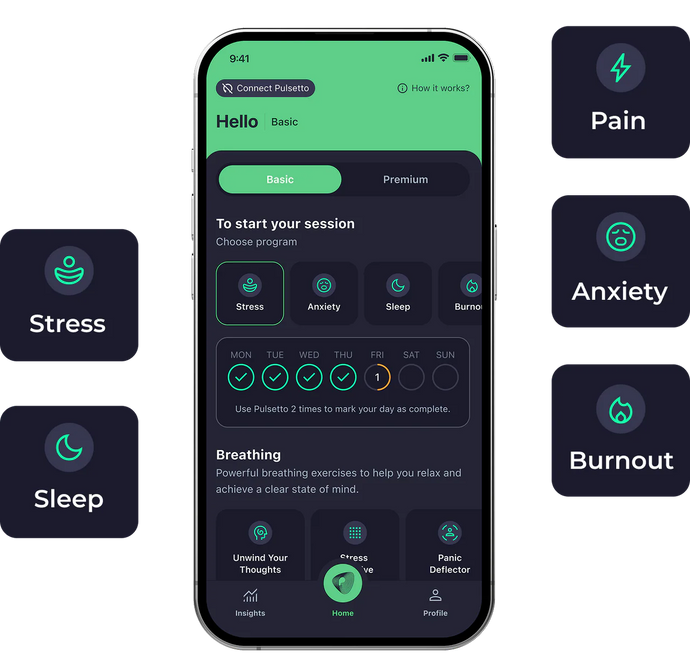
Pulsetto Vagus Nerve Stimulator
Pulsetto FIT bundle · Free shipping
$296 $546
✓ 30-day money-back guarantee · 2-year warranty
Order Pulsetto Now →Vagus nerve stimulation
A transcutaneous stimulator applies a mild electrical pulse to a branch of the vagus nerve, biasing the autonomic system toward parasympathetic activity. Mechanically it aims at the same target as slow breathing, delivered more directly and without requiring you to concentrate.
Where it fits: the physiological end of stress rather than the cognitive end. If your stress presents as a body that stays wired — tight chest, shallow breathing, difficulty settling in the evening — that is what this addresses. If it presents mainly as rumination, a device will not touch the thoughts, and the cognitive tier is where your effort belongs.
The honest framing: consumer stimulators are general wellness products, not treatments for anxiety or any medical condition. The most consistent finding in the research is a measurable shift in HRV; evidence for subjective stress is thinner, from small studies with short follow-up. And the mechanism is explained in more detail in how vagus nerve stimulation works.
Do not use one without speaking to your physician if you have an implanted electronic device, a cardiac arrhythmia, carotid artery disease, are pregnant, or take medication affecting heart rate or blood pressure.
What to Skip
- Cortisol "detox" supplements and drinks. You need cortisol. The goal is a stress response that resolves, not a hormone eliminated. We took this apart in the cortisol craze of 2026.
- Alcohol as a wind-down. Reduces subjective tension in the moment and fragments sleep afterwards, which lowers next-day stress tolerance. The loop closes against you.
- Stress tracking without stress changing. Watching your HRV decline is information, not intervention — and for some people it becomes its own source of anxiety.
- Buying a device before fixing sleep and movement. Sequence matters. A stimulator layered onto five hours of sleep and no exercise is optimising the wrong variable.
Assembling It Into Something You Will Actually Do
A realistic starting stack, in order of how much it will move:
- Fix your wake time. Same time, seven days. This week.
- Three thirty-minute walks a week. Outdoors if possible — morning light does double duty.
- One protected recovery block per working day. Fifteen minutes, no screen, in the calendar.
- Ten minutes of slow breathing in the evening, or a stimulation session if you use one.
- Add a cognitive tool once the first four are habitual — a thought record, a structured programme, or a few sessions with a therapist.
Give it a month. Judge it on how you sleep and how quickly you recover after something goes wrong, not on whether you feel calm on any particular Tuesday.
Frequently Asked Questions
What reduces stress most reliably without medication?
Regular aerobic exercise and consistent sleep. Both are structural — they reduce how much stress reaches you rather than helping you recover afterwards. Most people shop for acute tools while neglecting these two.
Is stress actually bad for you, or is that overstated?
Acute stress is normal and useful. The problem is chronic activation without recovery. The goal is not eliminating stress but restoring the ability to come back down.
How is cognitive behavioural therapy different from just thinking positively?
CBT is structured skills training: identifying thought patterns that amplify a stressor, testing them against evidence, and changing the behaviour that follows. The effects persist after treatment because you keep the skills.
Do breathing exercises really work or is it placebo?
The mechanism is real and measurable — slow breathing with a long exhale raises vagal activity and HRV. What it does not do is resolve the situation causing the stress, which is where people conclude it failed.
Where does vagus nerve stimulation fit?
It targets physiological arousal rather than the thoughts driving it, making it a complement to exercise, sleep and cognitive work rather than a replacement. Consumer devices are general wellness products, not treatments for anxiety.