

Affiliate Disclosure: This website is an independent affiliate site. We may earn a commission if you purchase through links on this page, at no extra cost to you. See our full disclosure and editorial policy.
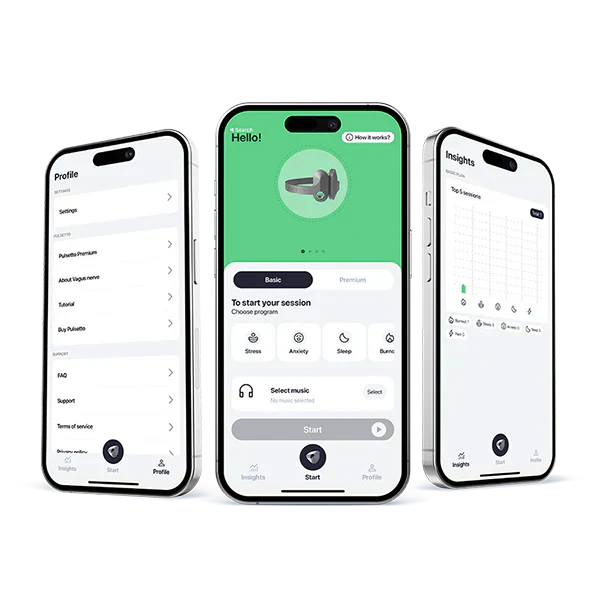
Short answer: the Pulsetto app is a controller, not a content library. It pairs with the device over Bluetooth, lets you pick one of five stimulation programs, and sets intensity. Sessions run about four minutes. The app is free, there is no subscription, and there are no per-use limits.
Most of what determines whether you get anything out of the device is not in the app at all — it is gel, electrode placement and intensity. Those three account for nearly every "I don't feel anything" message we get. They are covered below.
This is a usage guide, not medical advice. Pulsetto is a general wellness product and is not intended to diagnose, treat, cure or prevent any disease.
Setup, Once
- Charge the device fully before first use. USB-C.
- Install the app — free on the App Store and Google Play — and create an account.
- Turn the device on and pair over Bluetooth. It should appear within a few seconds. If it does not, toggle Bluetooth off and on, and make sure the device is not still paired to another phone.
- Apply the conductive gel to both electrode pads. A thin, even layer on each — this is not optional and it is the single most common thing people under-do.
- Position it around the back of the neck so the two pads sit on either side, roughly level with the middle of the throat, along the sides rather than at the back.
The device is bilateral — it stimulates both sides at once, which is why placement symmetry matters more than it would on a single-sided device.
The Five Programs
All five deliver stimulation to the same nerve at the same site. What differs is the waveform pattern and session structure — the app is selecting a protocol, not a different anatomical target. That is worth knowing, because it sets a realistic expectation: these are variations on one mechanism, not five distinct treatments.
1. Stress Relief
The general-purpose program and the right place to start. Designed for daytime use when you notice tension building rather than after it peaks. This is the one to use for your first week while you dial in placement and intensity, because you will be using it often enough to learn what "correct" feels like.
2. Anxiety
A gentler, longer-feeling protocol aimed at the physical component of anxious arousal — the tight chest and shallow breathing rather than the thoughts. Worth being precise about what this is for: it addresses body state, not cognition, and it is not a treatment for an anxiety disorder. If anxiety is significantly affecting your life, that belongs with a physician.
3. Sleep
Intended as the last step of a wind-down routine, not as something to run in bed hoping for unconsciousness. It works best when the rest of your evening has already done its job — lights dim, screens down, room cool. It is not a sedative and it will not override a bedroom that is too warm or a mind that is still working.
4. Burnout
A longer, lower-intensity protocol positioned for recovery periods rather than acute moments. Realistically, burnout is a situational problem — chronic demand without recovery — and no four-minute session solves it. This program supports the physiological recovery side while you address the workload side. We wrote about the structural half of that in the low-stress office.
5. Pain Management
The program with the most caveats attached. Vagal stimulation has documented effects relevant to certain headache types — gammaCore, a different handheld cervical device, holds FDA clearance for acute cluster headache and migraine pain. Pulsetto is a wellness device without those clearances, so treat this program as general relaxation support rather than pain treatment. Persistent pain needs a diagnosis, not a gadget.
Setting Intensity Correctly
The most consequential setting, and the one most people get wrong in both directions.
Start at the lowest level and step up gradually. You are looking for a clear but comfortable tingle — a light buzz you are aware of and could ignore. That is the target.
Signs you have gone too high: a sharp or prickly sensation, a visible twitch in the neck muscles, or any discomfort you are tolerating rather than not noticing. Turn it down. Higher intensity is not a stronger dose of benefit; past a point it just becomes an unpleasant sensation you will stop wanting to repeat.
Signs you are too low, or something else is wrong: you feel nothing at all. Before raising intensity further, check the gel and the placement. In practice, dry pads and electrodes sitting too far back are the culprit far more often than the setting.
Pulsetto Vagus Nerve Stimulator
Pulsetto FIT bundle · Free shipping
$296 $546
✓ 30-day money-back guarantee · 2-year warranty
Order Pulsetto Now →Building a Routine That Survives Week Two
The failure mode for this category of device is not that it feels bad — it is that it ends up in a drawer by day ten. Attaching it to something you already do reliably is the fix.
- Morning: a stress relief session with coffee, before the first meeting. Anchored to an existing habit.
- Evening: a sleep session after the shower, lights already dim, before you get into bed.
- As needed: anxiety or stress relief when you notice the physical signs building — not after you are already fully activated.
Two to three weeks of daily use before you form a judgement. The device's return window exists for exactly this, and using it as a real trial period is the sensible move: keep brief notes on sleep and stress, and decide on your own data rather than on how you feel about the purchase.
Common Mistakes
- Skimping on gel. The most frequent cause of "it does nothing." Conduction is the whole mechanism.
- Placement too far back. The pads need the sides of the neck, not the nape.
- Cranking the intensity. Sharp is wrong. Comfortable is correct.
- Using it as a rescue tool only. Reaching for it at peak stress and concluding it failed. Consistent daily use is where the reported benefit sits.
- Not cleaning the pads. Dried gel residue degrades contact over time. Wipe after each session.
- Expecting a sedative. It shifts autonomic state. It does not switch you off.
Safety and Who Should Not Use It
Do not use the device, and consult your physician first, if you have an implanted electronic device such as a pacemaker or defibrillator, a history of cardiac arrhythmia, carotid artery disease, are pregnant, have had neck surgery, or take medication affecting heart rate or blood pressure. The vagus nerve influences cardiac rhythm directly — these exclusions are substantive, not legal decoration.
Stop and seek advice if you experience dizziness, an irregular heartbeat, persistent skin irritation, or a headache that follows sessions consistently.
Frequently Asked Questions
Do I need a subscription to use the Pulsetto app?
No. The app is free for iOS and Android and the five core programs come with the device. No per-session limits, no per-use fees.
How long is a session and how often should I use it?
About four minutes. Most people use it once or twice daily — typically morning and evening. Consistency over two to three weeks matters more than session length.
What intensity should I set it to?
Start low and increase until you feel a clear but comfortable tingle. Sharp sensation or a visible muscle twitch means turn it down. Higher is not better.
Which program should I start with?
Stress relief, for the first week, while you learn how the device feels and where the electrodes sit best. Move to a specific program once placement and intensity are consistent.
Why do I not feel anything during a session?
Almost always insufficient gel, electrodes too far back or too high, or intensity too low — in that order of likelihood. Reapply gel, reposition forward along the side of the neck, then raise intensity one step at a time.