

Affiliate Disclosure: This website is an independent affiliate site. We may earn a commission if you purchase through links on this page, at no extra cost to you. See our full disclosure and editorial policy.
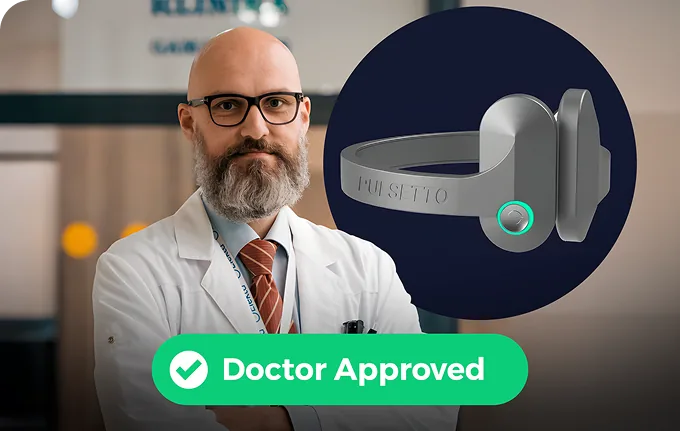
Short answer: only two of the four devices most often compared here deliver actual electrical stimulation to the vagus nerve. Pulsetto does it at the neck, hands-free and bilaterally, at around $296. Nurosym does it at the ear, with the deepest published evidence base in the consumer category, at roughly triple the price. Apollo Neuro and Sensate use vibration rather than current — they are nervous system tools, but calling them vagus nerve stimulators stretches the term.
That distinction is the most useful thing in this article, so it goes first. Everything else is a matter of fit.
Disclosure worth repeating: this site earns a commission if you buy Pulsetto through our links. We have tried to write the comparison we would want to read before spending $300, including the parts that do not favour us. Judge it accordingly, and read the full disclosure.
The Real Dividing Line: Current vs Vibration
Marketing in this category uses "vagus nerve stimulation" loosely, and the loose usage hides a genuine mechanical difference.
True transcutaneous electrical stimulation passes a small current through the skin to a branch of the vagus nerve, at the neck or at the ear. This is the same mechanism as the medical devices, at much lower intensity. Pulsetto and Nurosym are in this group.
Indirect approaches use vibration or sound to influence autonomic state. Apollo Neuro delivers haptic vibration at the wrist or ankle. Sensate uses infrasonic vibration on the chest, paired with app soundscapes. There is a reasonable argument that these engage parasympathetic pathways — vibration and slow rhythmic input do affect arousal — but no current reaches the vagus nerve.
Neither approach is automatically better. But if you are specifically shopping for vagus nerve stimulation because you read about the mechanism, you should know which group a device is in before you pay for it.
The Four, Side by Side
| Feature | Pulsetto | Nurosym | Apollo Neuro | Sensate |
|---|---|---|---|---|
| Method | Electrical (tVNS) | Electrical (tVNS) | Haptic vibration | Infrasonic vibration + sound |
| Placement | Neck, both sides | Ear | Wrist or ankle | Chest |
| Hands-free | Yes | Yes, wired to unit | Yes | Yes, lying down |
| Typical session | ~4 minutes | Longer, often 30+ min | Continuous wear | ~10 minutes |
| Consumables | Conductive gel | Ear clip | None | None |
| App subscription | Not required | Not required | Subscription tiers | Optional Plus tier |
| Indicative price | From $296 | Around $825 | From ~$349 | From ~$289 |
Prices are indicative and move with promotions and region. Check each manufacturer's current pricing before deciding — ours included.
Pulsetto
What it is: a neck-worn band with two gel electrodes delivering bilateral electrical stimulation, controlled by a free app with five programs. Sessions run about four minutes.
Where it wins: form factor and friction. It is genuinely hands-free — you put it on and it stays put, which means you can do something else during a session. Four minutes is short enough that the routine survives a busy week, and the app has no subscription. On price it sits well below Nurosym while remaining in the true-electrical category.
Where it does not: the gel is a real ongoing annoyance and the most common cause of a disappointing first week. The published evidence base is thinner than Nurosym's. And the five programs are variations on one mechanism rather than five distinct treatments — useful framing, but not five different technologies. Our full review goes into the limits in more detail.
Pulsetto Vagus Nerve Stimulator
Pulsetto FIT bundle · Free shipping
$296 $546
✓ 30-day money-back guarantee · 2-year warranty
Order Pulsetto Now →Nurosym
What it is: auricular transcutaneous stimulation via an ear clip connected to a handheld control unit. Sold as Nuropod in some markets.
Where it wins: evidence. Among consumer devices in this category, Nurosym is generally credited with the deepest published research base, and if what you want is the option with the most peer-reviewed work behind it, this is the honest answer regardless of who is writing the comparison.
Where it does not: price, at roughly triple Pulsetto's, which is a serious barrier for a first purchase in a category where you cannot know in advance whether you respond. The wired ear clip is more tethered and less convenient for daily use, and sessions run considerably longer.
Apollo Neuro
What it is: a wearable for the wrist or ankle delivering patterned haptic vibration, developed by neuroscientists and physicians, with different modes intended for different states.
Where it wins: it is the only one designed for continuous wear. No session, no setup, no consumables — you put it on and forget it. For someone who will not reliably sit down for a four-minute protocol, that difference matters more than mechanism purity.
Where it does not: it is not electrical stimulation of the vagus nerve, and describing it as a vagus nerve stimulator is a stretch. Some functionality sits behind subscription tiers, which changes the real cost over time.
Sensate
What it is: a smooth pebble-shaped device resting on the chest, combining infrasonic vibration with app soundscapes for roughly ten-minute guided sessions.
Where it wins: it is the most pleasant to use, and that is not a trivial advantage in a category where abandonment is the main failure mode. No gel, no electrodes, no current — the session is closer to a guided meditation with a physical component. Entry price is the lowest of the four.
Where it does not: same caveat as Apollo. It is a relaxation device, not a vagus nerve stimulator in the electrical sense. It also requires lying down, which rules out using it during a working day.
What Price Actually Buys You
There is a pattern worth naming. In this category, higher price generally correlates with more published research — the expensive devices fund studies, and studies are what separate a plausible mechanism from a demonstrated effect.
What price does not reliably buy is a better daily experience. The device you keep using is the one that fits your life, and that has more to do with form factor, session length and setup friction than with cost. A well-evidenced device in a drawer helps nobody.
Worth keeping in perspective: all four are consumer wellness products. None of them is FDA-approved to treat anxiety, depression or insomnia. The devices that hold that kind of clearance are different products — gammaCore for cluster headache and migraine pain, and implanted VNS for drug-resistant epilepsy and treatment-resistant depression, both requiring a prescription.
How to Choose
- You want electrical stimulation, hands-free, without a premium price → Pulsetto.
- You want the most published evidence and cost is secondary → Nurosym.
- You will not sit down for a session and need passive all-day support → Apollo Neuro.
- You want a pleasant, non-electrical wind-down ritual → Sensate.
- You have not fixed sleep timing or started moving regularly → none of them yet. Those two do more for stress than any device in this table, and they are free. We laid out the order in stress management without medication.
Whatever you pick, use the return window as an actual trial. Two to three weeks of daily use, brief notes on sleep and stress, and a decision based on your own data. Response in this category varies enough between individuals that no comparison table — including this one — can tell you how you will respond.
Frequently Asked Questions
Are Apollo Neuro and Sensate actually vagus nerve stimulators?
Not strictly. Both use vibration rather than electrical current — Apollo Neuro at the wrist or ankle, Sensate on the chest with soundscapes. They aim at the parasympathetic system indirectly. Pulsetto and Nurosym deliver true electrical stimulation.
What is the difference between neck and ear stimulation?
Cervical placement targets the main trunk near the carotid sheath; auricular targets the branch supplying part of the outer ear. Auricular has more published consumer-device research; cervical allows a hands-free wearable. Neither is decisively superior for general relaxation.
Which device has the strongest clinical evidence?
Among consumer devices, Nurosym — and it is also the most expensive. For the category overall, the strongest evidence belongs to prescription devices: gammaCore for cluster headache and migraine pain, and implanted VNS for epilepsy and treatment-resistant depression.
Is the cheapest device the worst?
No, but price tracks published research. What it does not track is daily usability, which determines whether you keep using the thing at all.
Which one should I buy?
Hands-free electrical at a moderate price points to Pulsetto; maximum evidence to Nurosym; all-day passive wear to Apollo Neuro; a guided non-electrical ritual to Sensate. Any of them is premature if sleep and movement are not sorted first.