

Affiliate Disclosure: This website is an independent affiliate site. We may earn a commission if you purchase through links on this page, at no extra cost to you. See our full disclosure and editorial policy.
Short answer: the vagus nerve is the main communication line between your brain and your internal organs, and most of its traffic runs upward, from body to brain. Vagus nerve stimulation applies a small electrical pulse to that line. The signal travels to the brainstem, which shifts the balance of the autonomic nervous system toward the parasympathetic side. The measurable result is usually a slower heart rate and higher heart rate variability. The subjective result — feeling calmer — is real for many people but harder to prove.
That paragraph is the whole mechanism. Everything below is the detail behind it, including the parts the marketing tends to skip.
What the Vagus Nerve Actually Is
Cranial nerve X. The name comes from the Latin for "wandering," which is a fair description of its route: it leaves the brainstem, passes down through the neck alongside the carotid artery, and branches out to the heart, the lungs, the stomach and most of the digestive tract. It is the longest cranial nerve in the body and the primary conduit of the parasympathetic nervous system.
Here is the detail that changes how you think about it. Roughly four fifths of vagal fibres are afferent — they carry information from your organs to your brain. Your gut, heart and lungs are constantly reporting upward, and that stream shapes mood and arousal far more than most people assume. The vagus nerve is less a control cable and more a sensory feed.
This is why stimulating it from outside works at all. You are not sending an instruction to the heart. You are injecting a signal into a sensory channel the brain is already listening to.
The Signalling Pathway, Step by Step
The chain is short and reasonably well mapped:
- The electrode delivers a pulse. Low current, applied where a branch of the nerve runs close to the skin — either the side of the neck or a specific part of the outer ear.
- Afferent fibres carry it upward to the brainstem.
- It arrives at the nucleus tractus solitarius (NTS), the brainstem's main relay for incoming body signals.
- The NTS projects onward to regions involved in arousal and emotional processing, including the locus coeruleus, the amygdala and the hypothalamus.
- Autonomic balance shifts toward parasympathetic activity. Heart rate typically drops slightly; heart rate variability typically rises.
That last step is the one you can actually measure, and it is the reason HRV appears in almost every study and every product page in this category.
Why Heart Rate Variability Keeps Coming Up
Heart rate variability is the variation in time between consecutive heartbeats. A healthy heart does not tick like a metronome — the gaps flex slightly with each breath. That flexibility is largely vagally mediated, which makes HRV a convenient, non-invasive proxy for parasympathetic activity.
Higher HRV generally indicates a nervous system that can shift states easily. Chronically low HRV is associated with stress load, poor sleep and reduced recovery capacity. When a study reports that a stimulation protocol "worked," an HRV change is very often what it is reporting.
Two honest caveats. HRV varies enormously between individuals, so your number is only meaningful against your own baseline — comparing it to a friend's tells you almost nothing. And an HRV shift during a session is not the same as a durable change in how you feel over weeks. The first is easy to demonstrate; the second is what you actually care about.
Implanted vs Transcutaneous: A Real Distinction
These get conflated constantly in marketing copy, and the difference matters.
Implanted VNS is surgery. An electrode is wrapped directly around the cervical vagus nerve and connected to a pulse generator placed under the skin of the chest. The FDA approved it in 1997 as an adjunctive therapy for drug-resistant partial-onset seizures, extended it to treatment-resistant depression in 2005, and lowered the paediatric age threshold in 2017. It is a prescribed medical intervention with decades of clinical data behind it.
Transcutaneous VNS (tVNS) stimulates through intact skin. No surgery, much lower current, and inevitably a less precisely targeted signal — some of the current disperses through surrounding tissue rather than reaching the nerve. There are two main placements: cervical, at the side of the neck, and auricular, at the outer ear, where a branch of the vagus supplies a small patch of skin.
Some transcutaneous devices have gone through formal regulatory review for specific indications. gammaCore, a handheld cervical device, received FDA clearance in April 2017 for acute treatment of pain associated with episodic cluster headache, and a label expansion in January 2018 for acute migraine pain.
Consumer relaxation devices are a different regulatory category. They are sold as general wellness products — which is a genuine legal distinction, not a technicality. It means the manufacturer is not claiming to treat any disease and has not been required to prove that it does.
What the Evidence Supports — and Where It Thins Out
Being straight about this is more useful than being enthusiastic.
Reasonably well supported: stimulating the vagus nerve transcutaneously produces measurable autonomic changes, most consistently in HRV. The mechanism is plausible and the anatomy is not in dispute.
Promising but unsettled: effects on subjective stress, anxiety and sleep quality. Studies exist, several are positive, and most are small, short and run by parties with an interest in the outcome. Follow-up periods are usually weeks, not months.
The blinding problem. This is the structural weakness of the whole field. You can feel the stimulation. That makes a convincing placebo control genuinely hard to construct — sham conditions either feel like nothing, in which case participants guess correctly, or they deliver some stimulation, in which case they may not be inert. Anyone who tells you this category has been rigorously placebo-controlled is overselling.
Not supported: any claim that a consumer stimulator treats anxiety disorders, depression, insomnia or an inflammatory condition. Those claims belong to prescribed devices with the trial data to back them, and the distinction is not a formality.
What It Actually Feels Like
Mild. Most people describe a light tingle, buzz or gentle pulsing at the contact point. Turned up too high it can feel prickly or produce a slight muscular twitch in the neck — the signal to turn it down, not to push through.
Some people notice a shift during a session: a drop in shoulder tension, a slower breath, the specific quality of tiredness that precedes actual sleepiness. Others feel nothing at all and only notice a difference, if any, after a few weeks of consistent use. Both responses are common enough that neither is evidence of anything.
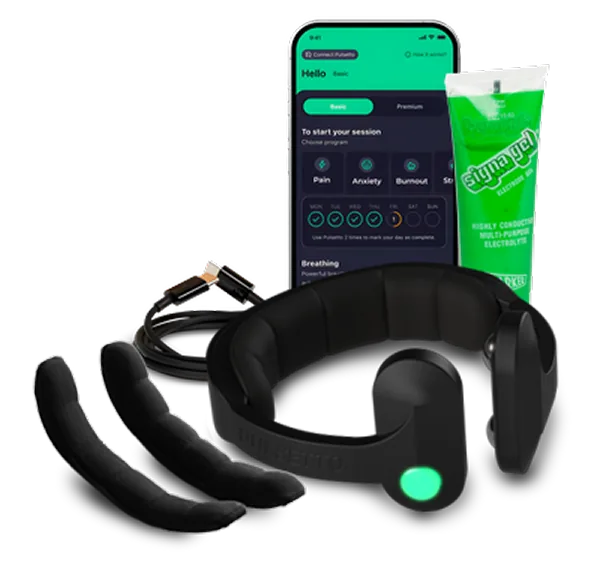
Pulsetto Vagus Nerve Stimulator
Pulsetto FIT bundle · Free shipping
$296 $546
✓ 30-day money-back guarantee · 2-year warranty
Order Pulsetto Now →Doing It Without a Device
The vagus nerve responds to plenty of things you already have access to:
- Slow breathing with an extended exhale. The most reliable free method. Vagal activity rises on the out-breath, so lengthening the exhale relative to the inhale biases the system parasympathetic. Six breaths a minute is a common target.
- Humming, chanting or singing. The vagus supplies the larynx; vocal vibration engages it directly.
- Cold water on the face. Triggers the mammalian dive reflex, which drops heart rate through vagal pathways.
- Gargling. Same mechanism as humming — muscle engagement in the throat.
- Slow, rhythmic movement. Walking, swimming and easy cycling all raise HRV over time.
None of this costs anything. If you are deciding whether a device is worth buying, the honest framing is that you are paying for consistency and convenience — a structured four-minute session you will actually do — rather than for access to an effect that breathing cannot reach.
Who Should Not Use One
Do not use a vagus nerve stimulator, and speak to your physician first, if you have an implanted electronic device such as a pacemaker or defibrillator, a history of cardiac arrhythmia, carotid artery disease, are pregnant, have had neck surgery, or take medication that affects heart rate or blood pressure. This is not boilerplate. The vagus nerve influences cardiac rhythm directly, which is exactly why the effect is interesting and exactly why these exclusions exist.
The Bottom Line
The mechanism is real and reasonably well understood. The anatomy is not controversial, the signalling pathway is mapped, and the autonomic effect is measurable. What remains genuinely uncertain is how much of that translates into feeling better over months, for a given person, from a consumer-grade device.
That is a more modest claim than most product pages make — including, at times, ours. It is also the claim the evidence currently supports. If you buy one, treat the return window as the actual experiment: use it daily for two to three weeks, track your sleep and stress with your own notes, and judge it on your data rather than anyone's marketing.
Frequently Asked Questions
What does the vagus nerve actually do?
It is cranial nerve X, the longest cranial nerve, running from the brainstem through the neck to the heart, lungs and digestive tract. About 80% of its fibres carry information from the body up to the brain rather than commands downward. It is the main pathway of the parasympathetic nervous system.
How does electrical stimulation of the nerve create a calming effect?
The pulse travels up the afferent fibres to the nucleus tractus solitarius in the brainstem, which projects to regions involved in arousal and emotional regulation. Autonomic balance shifts toward parasympathetic activity, usually showing up as a slower heart rate and higher HRV.
Is transcutaneous stimulation the same as the implanted medical device?
No. Implanted VNS is surgical and FDA-approved for drug-resistant epilepsy and treatment-resistant depression. Transcutaneous devices work through intact skin with a weaker, less targeted signal, and consumer versions are sold as general wellness products rather than medical treatments.
What does the evidence actually support?
The strongest evidence is for the implanted device in its approved indications. For transcutaneous stimulation, the most consistent finding is a measurable HRV shift. Evidence for subjective stress, anxiety and sleep is mixed, with small studies, short follow-up and real difficulty constructing a convincing placebo.
Can I stimulate the vagus nerve without a device?
Yes, indirectly — slow breathing with a long exhale, humming, gargling, cold water on the face and singing all engage vagal pathways at no cost. A device buys convenience and consistency, not a fundamentally different category of effect.